

FLAC and WAV are both lossless digital audio formats that promise studio-grade sound quality. But what exactly sets them apart? If you are planning to purchase a high-resolution track, which format should you choose? Furthermore, which streaming platforms support these formats, and can you download the music to FLAC or WAV files from them? Check out our comprehensive guide below for all the answers.
Related:
FLAC stands for Free Lossless Audio Codec, an audio format similar to MP3 but lossless, meaning the audio is compressed in FLAC without any loss of quality. It’s royalty-free and is considered the preferred format for downloading and storing hi-res albums. The downside is that it’s not supported by Apple Music/iTunes.
WAV is an audio file format standard developed by IBM and Microsoft. It is the main format used on Microsoft Windows systems for uncompressed audio. It’s also a lossless digital format preserving the original music quality.
While FLAC is a compressed audio format, there should be no “loss” in terms of how it sounds. Based on this, FLAC can be nearly half the size of an uncompressed WAV or AIFF of equivalent sample rate.
Though a WAV file can contain compressed audio, the most common WAV audio format is uncompressed linear pulse-code modulation (LPCM). Since LPCM is uncompressed and retains all samples of an audio track, professional users or audio experts may use the WAV format with LPCM for maximum audio quality. LPCM is also the standard audio coding format for audio CDs, which store two-channel LPCM audio sampled at 44.1 kHz with 16 bits per sample.

WAV files can also store metadata like album art or artist details, but the real issue is software compatibility. Because there is no universal industry standard for how WAV metadata is written, many media players, car dashboards, and audio applications fail to read the tags, often displaying your music as “Unknown Artist.” Furthermore, native WAV metadata structures struggle to reliably hold heavy image files like high-resolution album artwork.
While FLAC completely solves this problem. It uses a rock-solid, universally standardized metadata system (Vorbis comments) that ensures album art, lyrics, and track info display perfectly across all compatible devices.
WAV has wider compatibility than FLAC. WAV can be played with Windows Media Player, Winamp, iTunes/Apple Music, VLC Media Player, QuickTime Player, or VOX.
Note that the iTunes/Music app can’t play FLAC songs. If you prefer FLAC songs, you can use VLC Media Player, QuickTime Player, Winamp, MediaMonkey, Songbird, or VOX for Mac, iPhone, and iPod.

There are several online platforms where you can purchase FLAC or WAV music. Here are some popular options:
It’s important to note that WAV files tend to be larger in size compared to other audio formats like FLAC or MP3. Ensure that you have sufficient storage space and compatible devices to handle WAV files if you choose to purchase them.
Additionally, some mainstream online music stores like iTunes Store and Amazon Music also offer WAV files for certain albums or tracks. Keep an eye out for specific format availability when browsing these platforms.
Tidal offers HiRes FLAC when you set audio quality to Max with supported devices. The audio quality can be up to 24-bit, 192 kHz. The “High” quality setting allows you to listen to over 110M songs in studio quality with FLAC up to 16-bit, 44.1 kHz.
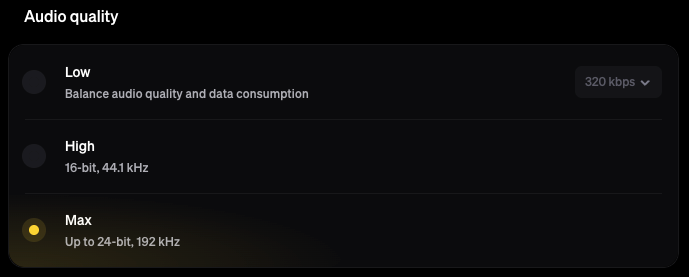
Although Tidal streams music in FLAC, you can’t download songs in FLAC as local files. Songs downloaded can only be played within the Tidal app.
To download FLAC songs from Tidal, you can use Pazu Tidal Converter, which is designed to download any Tidal songs, albums, and playlists to M4A/MP3/AAC/FLAC/WAV/AIFF on your Mac and Windows and save to your library.
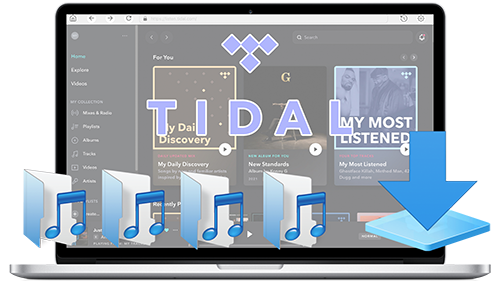
Download, install, and run Pazu Tidal Converter on your Windows, which features a built-in Tidal web player. Log into your Tidal account.
If you have purchased a license, click the key icon to register the converter. If not, continue using the trial version.

Click the gear icon and customize the download format, output folders, and other download settings. You can also customize the output song name with any combination of Title, Artist, Album, Track Number, and Playlist Index. Supported formats include:

Go to the playlist you want to download. Then click the red icon, and all songs in the playlist will be added by default. You can uncheck the songs you don’t want to get.

Click the Convert button to start downloading Tidal music to FLAC, WAV, or other formats you choose.

After conversion, click the folder icon to quickly locate the downloaded Tidal songs. You can then transfer and play it anywhere.

Pazu Apple Music Converter lets you convert Apple Music songs, albums and playlists to FLAC/WAV without any loss in quality. One of the distinguishing features of Pazu Apple Music Converter is that it can download and convert Apple Music at a very fast speed—almost 10 times faster than other similar software. It is integrated with the Apple Music web player, so you can batch convert any Apple Music playlist or album to the format you choose without the Apple Music or iTunes app.
In addition, Pazu Apple Music Converter can recognize and identify tracks as it downloads, and automatically tags the files with the relevant artist name, track title, and album tags as it goes. The downloaded songs are fully searchable by artist, title or album, creating your entire music library simply and quickly.
Download, install and run Pazu Apple Music Converter on your Mac or Windows.
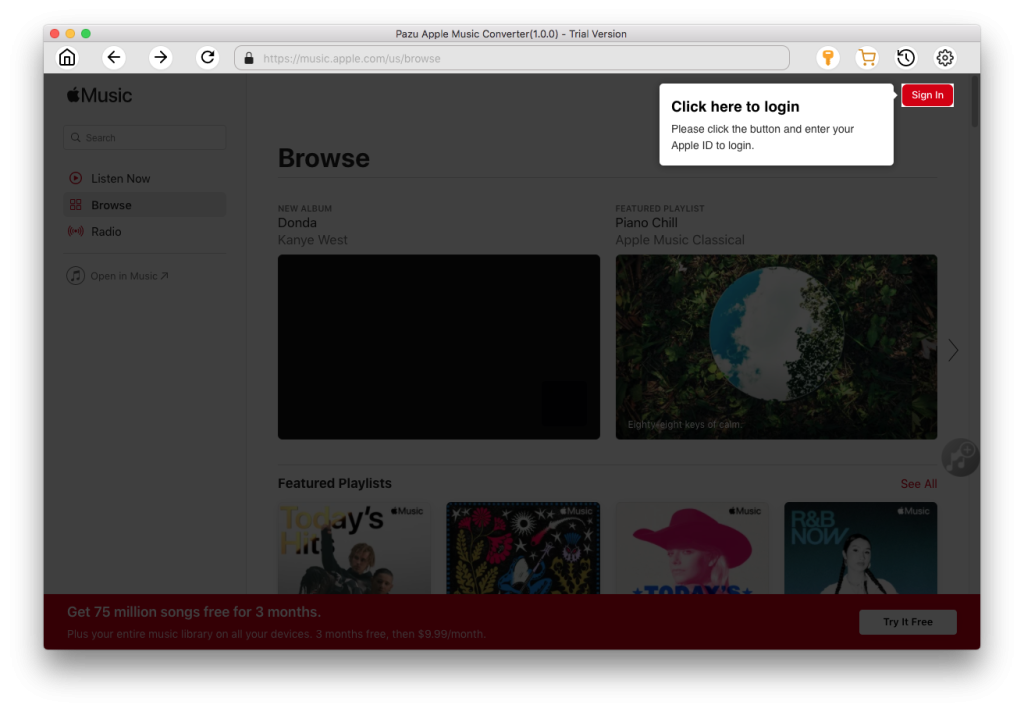
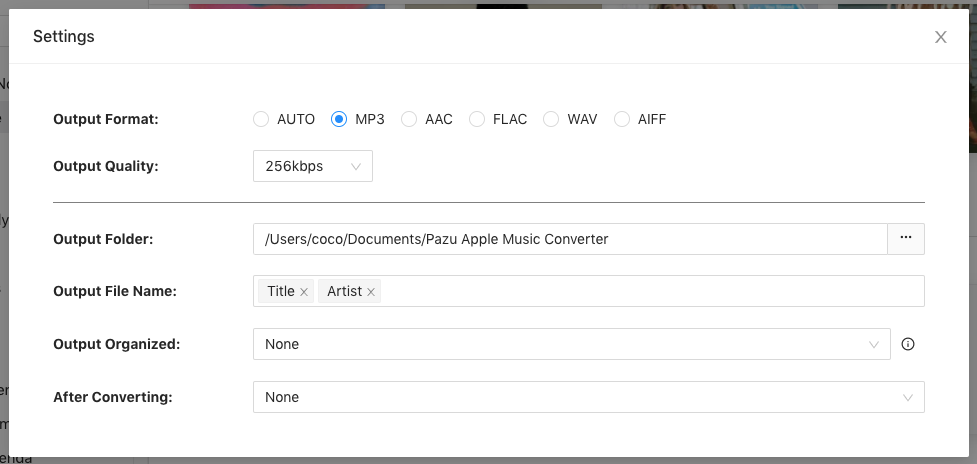
Click the gear icon in the top right corner and choose FLAC or WAV as the output format.
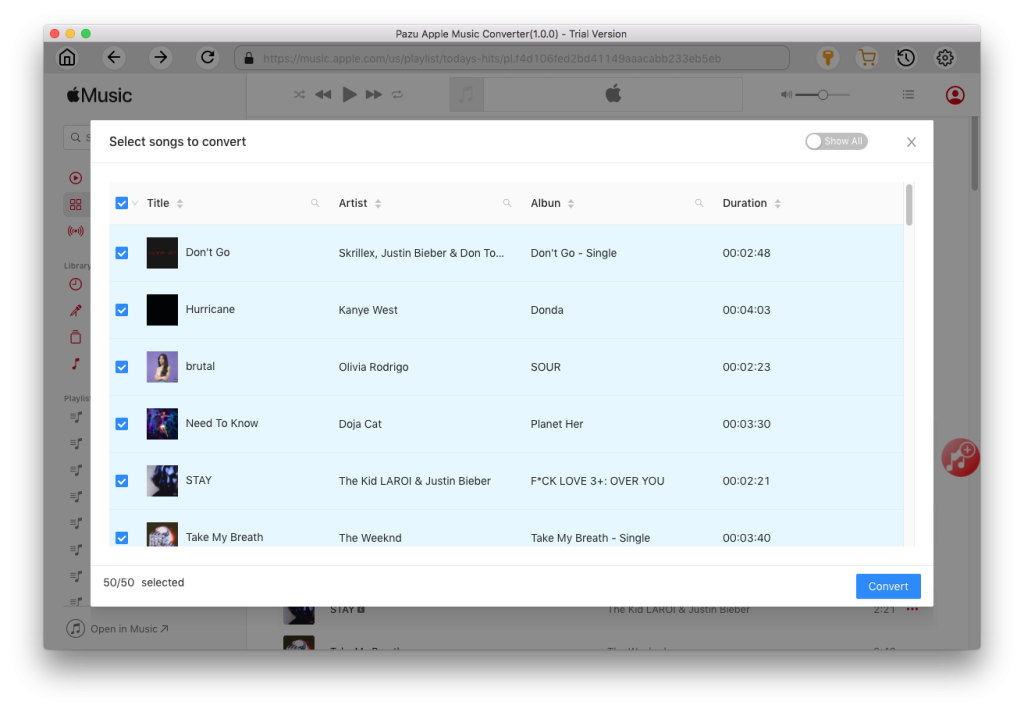
Go to a playlist, artist, or album. Click the red “Add songs” button to add all the songs to the download list. You can uncheck the tracks you don’t want to download.
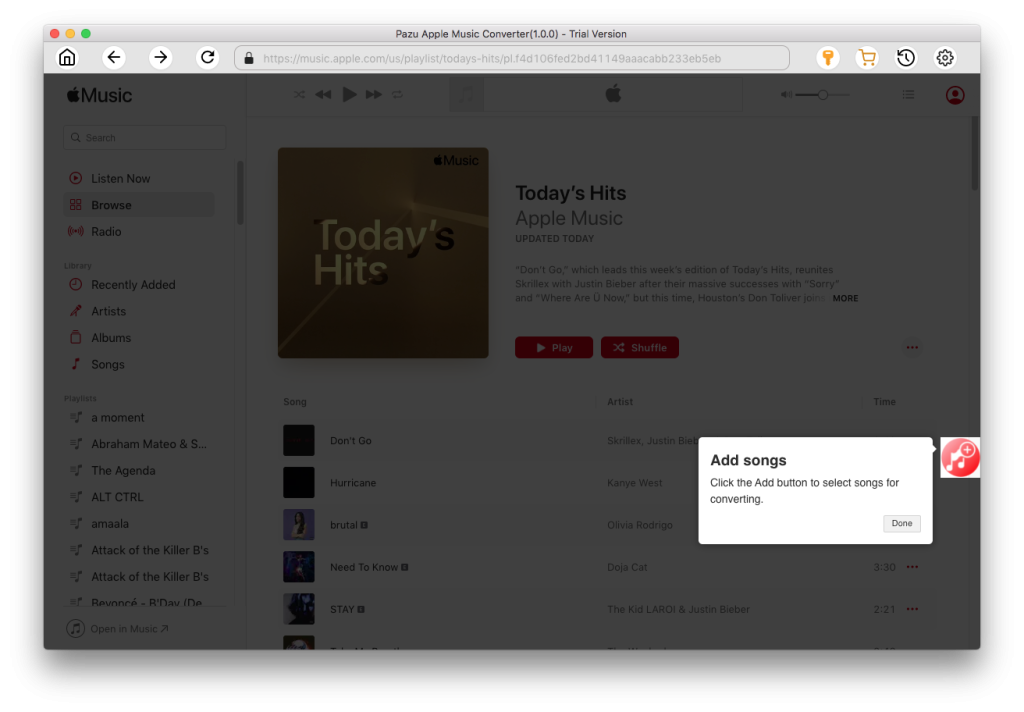
Click the “Convert” button to start downloading Apple Music songs, albums, and playlists to FLAC, WAV, or other formats you choose. You can play them anywhere you want, even after canceling your Apple Music subscription.

Download Apple Music to MP3, M4A, etc.